
The function and charm of Index Cutting

Before the advent of printing, the task of rubrication, in other words writing the initial letters of titles and paragraph captions in red, was entrusted to a special amanuensis known as a “rubricator”.
In the modern age, rubrication consists of creating a rubric, or index, for a publication, with the aim of helping readers find topics of interest faster.
Today, index cutting is performed by special numerically controlled machines that create the distinctive index tabs (or cuts) along the side of the printed material. This process is particularly suitable for publications with extensive content, where having a guide to find specific information is essential.
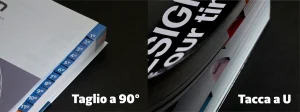
The technique is particularly useful for complex catalogues with numerous pages, such as catalogues with technical data sheets and assembly instructions.
There are different types of index cut, from the classic 90° cut or the same cut with rounded corners, to the 120° cut, and even the thumb cut or step cut (or cut tabs), which are recommended for catalogs with a small number of pages.
Finally, you can customize this feature to your liking by creating different shapes and designs that best suit your project, making it unique and functional at the same time.
Contact us to develop your next project together.


